
Toulouse, an innovative and sustainable metropolis
A development and economic diversification strategy geared towards Campuses of Excellence.
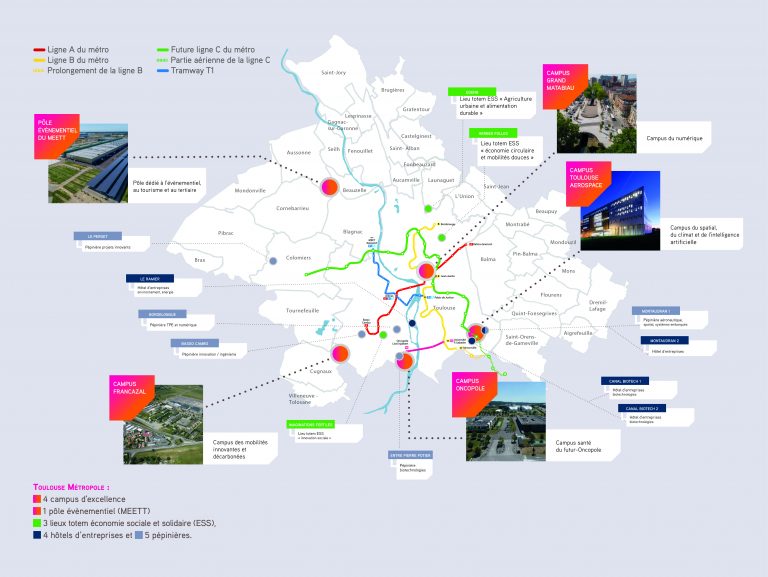
Toulouse Métropole intends to enable the strategic sectors and ecosystems of the territory to have an address and real places of excellence around 4 priority campuses and an events hub.
The economic development, location and attractiveness strategy of the Toulouse metropolitan area is centered around these campuses and flagship locations:
- CAMPUS TOULOUSE AEROSPACE aeronautics, space, drones and embedded systems
- CAMPUS HEALTH OF THE FUTURE-ONCOPOLE, Biotechnology, bioproduction
- CAMPUS FRANCAZAL, innovative and decarbonized mobility, new energies
- CAMPUS GRAND MATABIAU, digital technology, artificial intelligence, cybersecurity
Nurseries: an innovative network
Toulouse Métropole provides startups and innovative companies with a real estate portfolio of more than 20,000 m² spread across 9 sites (business incubators and business hotels).
The service offering is distinguished by modular premises from 12 to 150 m² (offices, equipped Biotech laboratories, industrial production workshops, technical platforms), flexible and progressive accommodation conditions, and activities promoting networking.
For the past 30 years, the business incubators and business centers of Toulouse Métropole have shown a very positive track record:
- 91% 5-year survival rate
- 100 companies hosted on average per year
- 92% occupancy rate
- 80,5% of active businesses have their headquarters in the metropolitan area.
- recognized success stories: Delair, Naïo technologie, EasyMile, Wiseed, iTerop, Novelab, Adveez, Flash thérapeutics, Cell-Easy, My American Market, Epsilon Ingénierie, Nexio Groupe, Pole Star, Opisto, ZeWatt, LDL Technology, Rubix, Limatech, Kyanos, etc.
Major investments: 3rd metro line
In 2028, a third metro line will serve the Toulouse metropolitan area and more than 200,000 jobs, running from east to west, from Colomiers to Labège. Twenty-one stations along a 27 km route will revolutionize the daily lives of workers and boost the metropolitan area's appeal by serving five multimodal transport hubs.
By linking the main employment hubs and business areas in record time, line C will allow many workers to use fast, reliable, and economical public transport and avoid traffic jams.
From its inception, Line C was designed to meet the objectives of the region's ecological and energy transition. In a context of reducing consumption in agricultural and natural areas, metro stations will be hubs for housing and economic activity.
Furthermore, the construction of the line will allow the creation of more than 4500 jobs per year during the period of the works.